
Why Your Map Ranking Vanishes Three Miles From Your Store
Why Your Map Ranking Vanishes Three Miles From Your Store (And How to Fix It)
It is a scenario I see every single week in my consulting practice: A business owner opens their phone while sitting in their office, searches for their primary service, and sees their business sitting proudly at the #1 spot in the Google Map Pack. They feel like they’ve won the google business profile seo game. But then, they drive three miles down the road to grab lunch, perform the same search, and – poof – they’ve vanished. They aren’t just #2 or #3; they aren’t even on the first page of results.
This phenomenon is what I call the “Proximity Wall.” It is the invisible boundary where Google’s algorithm decides that a closer competitor is “good enough,” even if your business is objectively better, more established, and has higher ratings. To break through this wall, you must understand that local search isn’t just about where you are; it’s about how loudly your digital presence speaks. By mastering the three pillars of local SEO – Proximity, Relevance, and Prominence – you can stretch your visibility far beyond your immediate neighborhood. Mastering Organic Visibility: Local SEO Techniques for 2025 provides a foundation for this, but today we are diving deep into the map itself.
The Proximity Problem: Why Google Puts You in a “Local Box”
Google’s primary goal is to provide the most helpful result for the user. In the world of local search, “helpful” is often synonymous with “convenient.” This is why the “Distance” factor is the heaviest weight in the local algorithm. Google tracks the physical location of the user’s device (or the specific location mentioned in a search query) and prioritizes businesses within a tight radius. This creates the “Local Box” – a small geographic area where you are the dominant force.
The frustration for many business owners is that proximity is the one ranking factor you have the least control over. You can’t simply pick up your storefront and move it every time a customer searches from a different zip code. However, many businesses find that their business map pin is invisible to high-intent local shoppers simply because they haven’t given Google a reason to look past the distance factor. When you rely on a google maps ranking service, the first thing they will tell you is that proximity is a baseline, not a ceiling. If Google only sees you as a “nearby” option and not an “authoritative” option, your ranking will always crumble the moment a user crosses that three-mile threshold.
The “Local Box” is tightening, too. With the rise of mobile search and “near me” queries, Google has become increasingly granular. In densely populated urban areas, your ranking radius might even be less than a mile. To expand it, we have to stop fighting proximity and start over-indexing on the other two pillars of the algorithm.
The Three Pillars of Local SEO: Proximity, Relevance, and Prominence
To understand how to break the 3-mile barrier, we have to look at the official documentation and the data-driven research that fuels modern google business profile optimization. Google openly admits that local results are based primarily on three factors:
- Proximity (Distance): How far the user is from the business. This is the “proximity wall” we’ve discussed.
- Relevance: How well a local business profile matches what someone is searching for. This is about your categories, your content, and your keywords.
- Prominence: How well-known a business is. This is calculated based on information Google has from across the web, including links, articles, directories, and review signals.
The technical secret to “signal stretching” is this: Relevance and Prominence are the only tools capable of overriding the Distance penalty.
Think of it like this: If you are looking for a generic “coffee shop,” Google will show you the one 200 yards away. But if you are looking for the “best specialized espresso bar in the state,” Google may show you a result 10 miles away. Why? Because the Relevance (specialized espresso) and Prominence (the “best” with high authority) of the distant shop are so high that they outweigh the convenience of the shop next door. To expand your radius, your google business profile seo must convince Google that your business is so relevant and so prominent that it is worth the extra drive for the user.
Visualizing the Drop-Off: Using Map Grid Trackers
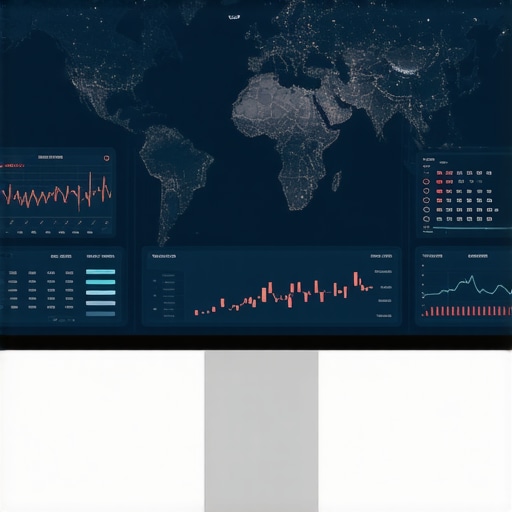
You cannot fix what you cannot measure. Most business owners look at their rankings as a single number (e.g., “I’m #1 for ‘Plumber'”). In reality, you don’t have one rank; you have thousands of ranks across a geographic grid. This is where professional google maps rank tracker tools become essential.
SEO professionals use grid tracking – usually a 13×13 or 15×15 grid of points – to visualize visibility. Each point on the grid represents a search performed from that exact latitude and longitude. A typical “proximity-locked” business will show a cluster of “green” (Rank 1-3) right over their office, surrounded by a sea of “red” (Rank 10+).
When you see this sudden drop-off, it is a diagnostic signal of a “relevance gap.” It means Google recognizes who you are when it’s easy, but it doesn’t trust your authority enough to show you to someone in the next town over. By using these tools, we can identify specific directions where your ranking is weak. Perhaps you rank well to the North but fail to the South. This allows for surgical optimization rather than guesswork. If you want to stop guessing about the hidden signals controlling your position, you must start by visualizing your current “geographic footprint.”
Strategy 1: Maximizing Relevance to Expand Your Radius
Relevance is the most immediate lever you can pull to rank google business profile higher in surrounding areas. You need to signal to Google that you are the absolute best choice for a specific query, regardless of the user’s distance. This starts with deep optimization of your profile’s data points.
First, audit your GBP Categories. Your Primary Category carries the most weight, but your Secondary Categories are what allow you to capture “long-tail” local searches. If you are a “Law Firm,” but you also specialize in “Personal Injury” and “Car Accidents,” those must be explicitly listed.
Second, utilize the Services and Products sections. Don’t just list the name of the service; provide a detailed description that includes geographic keywords. Instead of “Roof Repair,” use “Residential Roof Repair for [Neighborhood A] and [Neighborhood B].” This isn’t about keyword stuffing; it’s about providing context that Google’s NLP (Natural Language Processing) can use to associate your business with those specific areas.
Finally, use GBP Posts as a hyperlocal signaling tool. Instead of generic promotional posts, write about projects you’ve completed in specific neighborhoods. Mentioning landmarks, local events, or specific street intersections in your posts (and including photos from those locations) creates a “geo-relevance” trail that helps stretch your signal. For more on this, check out Hyperlocal Content: The Last Honest Way to Beat National Brands.
Strategy 2: Building Prominence Through Local Authority
Prominence is Google’s way of asking, “Does the rest of the world think this business is important?” If you want to break the 3-mile barrier, you need to build enough digital authority that Google feels confident recommending you over a closer, less-established competitor. This requires specialized local seo tools and a dedicated focus on off-page signals.
Review Velocity and Diversity are paramount here. It isn’t just about having a 5-star rating; it’s about how often you get reviews (velocity) and what people say in them (diversity). When a customer leaves a review saying, “The best HVAC technician in [City Name] helped us with our AC repair,” they are giving Google a massive relevance and prominence signal. This is why the review strategy that gets more 5-star ratings is often the difference between a local leader and a “parking lot” ranker.
Beyond reviews, Google looks at “information that Google has about a business, from across the web, like links, articles, and directories.” This means your local citations (NAP – Name, Address, Phone Number) must be perfectly consistent. But more importantly, you need local backlinks. A link from a local Chamber of Commerce, a neighborhood blog, or a local news outlet is worth ten links from generic national sites. These links act as “votes of confidence” in your geographic authority.
Hyperlocal Content: The Secret to “Signal Stretching”
Your Google Business Profile does not exist in a vacuum; it is tethered to your website. If your website only mentions your main office address, Google will likely keep you in that “local box.” To stretch your signal, you need a robust hyperlocal content strategy on your own domain.
This involves creating City-Specific Landing Pages or Service Area Pages. However, there is a right way and a wrong way to do this. Many businesses create thin, “cookie-cutter” pages where they just swap out the city name. This is a mistake. As I explain in Why Using City Names in Your Local Keyword Strategy Often Backfires, Google’s helpful content updates are designed to sniff out low-effort geo-targeting.
Instead, your service area pages should include unique content: testimonials from clients in that specific city, photos of work done in that area, and descriptions of local challenges (e.g., “Common roofing issues found in the historic homes of [Neighborhood Name]”). When your website proves you are an expert in a specific suburb, Google is much more likely to show your GBP to users in that suburb, even if you are five miles away.
Conclusion: Breaking the 3-Mile Barrier
The “Proximity Wall” is a formidable challenge, but it is not impenetrable. While you cannot move your building, you can absolutely move your “digital footprint” through strategic optimization. By focusing on the interplay between Relevance and Prominence, you can convince Google’s algorithm that your business is the most authoritative and useful result for users well beyond your immediate street corner.
Success in google business profile seo requires a shift in mindset. You are no longer just optimizing for a search term; you are optimizing for a geographic area. Start by auditing your current visibility, identifying your relevance gaps, and using professional tools to boost google business profile ranking. The goal is to make your business so prominent that Google can’t afford to ignore you, no matter where the user is standing.