
The Signal Gaps Stopping Your Business From Ranking in the Map Pack
The Signal Gaps Stopping Your Business From Ranking in the Map Pack
You have filled out every field. You have uploaded high-resolution photos. You have a handful of five-star reviews and your address is verified. Yet, when you search for your primary services, your business is nowhere to be found in the coveted top three spots of the Google Map Pack. You are stuck at position #4, #5, or worse – buried on page two. It is the ultimate frustration for any business owner: doing “everything right” according to the basic checklists and seeing zero movement in rankings.
As a Local SEO Strategist with over 15 years of experience, I have seen this plateau time and again. In the landscape of 2026, local search has evolved. It is no longer about mere completion of a profile; it is about signal strength, frequency, and authority. The “Signal Gaps” are the discrepancies in data, velocity, and entity authority that cause the current Google algorithm to favor your competitors over you. Even with a perfectly optimized Google Business Profile (GBP), it typically takes 30-90 days to see significant results in moderate markets. If you’ve waited longer and haven’t moved, you have a signal gap.
The Proximity Paradox: Why Being “Near” Isn’t Enough
Historically, proximity was the king of local search. If you were the closest business to the searcher, you won. However, we are now living in the era of the “Proximity Paradox.” Google’s algorithm rests on three pillars: Proximity, Relevance, and Prominence. While proximity is a fixed data point, it is increasingly treated as a “soft” signal that can be overridden by high prominence.
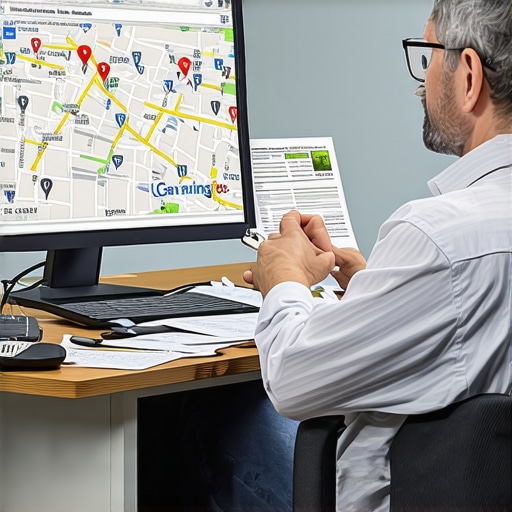
Have you ever wondered why a competitor located three miles away outranks you even when the searcher is standing right outside your front door? It is because their prominence signals – their digital footprint, review count, and brand mentions – are so overwhelming that Google deems them a “better” result for the user despite the extra travel time. To understand where these boundaries lie for your specific location, you must use a google maps rank tracker to visualize your “ranking heat map.” If your visibility drops off a cliff the moment you move one block away, your prominence is failing to support your proximity.
To overcome this, businesses must focus on expanding their “local reach” by building signals that prove to Google they are the dominant authority in the entire service area, not just the immediate 500-foot radius. This involves moving beyond the map pin and looking at how the rest of the web validates your location. For a deeper look at these specific issues, check out 3 Signal Gaps Killing Your 2026 Local Search Ranking [Case Study].
The Review Velocity Gap: The “Pulse” of Your Business
Most business owners focus on the total number of reviews. While a high total is important for social proof, the algorithm cares far more about “Review Velocity.” Review velocity is the speed and consistency at which you acquire new feedback. If you received 50 reviews three years ago but only two in the last six months, Google views your business as potentially stagnant or less relevant to current consumers.
A “Pulse Gap” occurs when there are long stretches of silence between customer reviews. In 2026, the algorithm uses these behavioral signals to determine if a business is still active and providing high-quality service. Steady, genuine new reviews keep your prominence fresh. Furthermore, the content within those reviews acts as a secondary relevance signal. When customers use specific keywords – like the name of a dish, a specific repair service, or a neighborhood name – they are effectively performing rank google business profile work on your behalf.
To bridge this gap, you need a systematic approach to feedback. It isn’t about a one-time “review blast,” which can actually trigger spam filters. Instead, it is about a consistent trickle of 3-5 reviews per week. If you find the process of asking for feedback daunting, you might find The Review Strategy That Earns 5-Star Ratings Without the Awkwardness incredibly helpful for building that necessary velocity.
NAP Consistency and the “Data Decay” Problem
NAP (Name, Address, Phone number) consistency has been a staple of SEO for a decade, but the way Google processes it has changed. We are now dealing with “Data Decay.” This happens when third-party aggregators, old directory listings, or even social media profiles contain outdated information that contradicts your Google Business Profile.
When Google’s crawlers find conflicting information – say, a different suite number on Yelp or an old phone number on a local news site – it creates “friction.” This friction lowers Google’s confidence in your business’s data. If Google isn’t 100% sure where you are or how to contact you, it will not risk its own reputation by ranking you in the top three. This is why google business profile optimization must extend beyond the GBP dashboard itself.
You must distinguish between “Structured Citations” (Yelp, Yellow Pages, Bing) and “Unstructured Citations” (mentions in local blogs, news articles, or community event pages). Both must be aligned. Even a slight variation, like “Street” vs “St,” while less critical than it used to be, can still contribute to a lack of data “crispness.” To identify where your data is decaying, read about the 4 Specific Gaps Your Google Business Profile Audit Is Probably Missing.
The Hyperlocal Content Gap: Connecting the Website to the Map
A major mistake businesses make is treating their website and their Google Business Profile as two separate entities. In reality, Google views them as a single “Entity.” If your GBP says you serve “Miami,” but your website never mentions specific Miami neighborhoods, landmarks, or local news, there is a hyperlocal content gap.
In 2026, AI-driven search models like Google Gemini look for deep entity relationships. Your website needs dedicated “City Pages” or “Service Area Pages” that offer unique, geo-targeted content. This isn’t just about swapping out the city name in the H1 tag. It’s about proving local expertise. Do you mention the local climate’s effect on your roofing materials? Do you talk about the specific traffic patterns that affect your delivery times? This level of detail bridges the gap between a generic business and a local authority. For more on this, explore Mastering Organic Visibility: Local SEO Techniques for 2025.
Furthermore, ensure your website uses Schema Markup (LocalBusiness structured data) to explicitly tell Google the relationship between your web URL and your Map Pack pin. This “hard-coding” of your location data prevents the algorithm from having to guess your service boundaries.
Technical GBP Gaps: Categories, Services, and Attributes
Sometimes the gap is purely technical. The “Category Selection Error” is one of the most common reasons for a ranking plateau. Many businesses select too many categories, thinking it will cast a wider net. In reality, adding irrelevant categories dilutes your primary relevance. If you are a “Plumber,” but you also add “HVAC Contractor” and “Electrician” without having the supporting content or reviews for those services, you may find your rankings for “Plumber” actually drop.
Another often-overlooked area is the “Services” menu within the GBP dashboard. Google often auto-populates these based on what it finds on your website or what users suggest. If these are inaccurate or messy, they create a signal gap. You should also be leveraging “GBP Posts” as a freshness signal. A business that posts updates, offers, and photos weekly tells Google that the lights are on and someone is home. To find these “hidden” technical missing links, I recommend using a google business profile audit tool to see exactly what the crawlers see. You can also follow The Only Google Business Profile Checklist You Need to See Real Phone Clicks to ensure no technical stone is left unturned.
2026 Algorithm Shifts: AI Search and Multi-Modal Clicks
We cannot discuss signal gaps without addressing the massive shift toward AI-integrated search. With the full rollout of Gemini Omni and Gemini Spark, Google is no longer just matching keywords; it is interpreting intent. AI now “reads” your images and customer reviews to answer highly complex queries. A user might search for: “Where is a quiet cafe with outdoor seating and fast Wi-Fi in downtown Austin?”
If your GBP photos don’t have descriptive alt-text (which Google generates via AI vision) or if your reviews don’t mention “fast Wi-Fi,” you won’t show up – even if you are the best cafe in town. This is the “Multi-Modal Gap.” Your images, your attributes (like “Outdoor Seating”), and your user-generated content must all align to feed the AI ecosystem. Google is also moving toward a “Universal Cart” and “Direct Action” model, where users can book or buy directly from the search results. If your profile isn’t “Action-Ready,” you are losing out on behavioral signals that Google uses to rank businesses higher.
The 2026 algorithm prioritizes businesses that provide a “complete answer” to a user’s problem. This means your profile must be a rich repository of data that goes far beyond name and address. It needs to be a living, breathing digital twin of your physical location.
Conclusion & Action Plan
Ranking in the Google Map Pack in 2026 is a marathon of signal maintenance, not a sprint of one-time optimizations. If you are stuck outside the top three, it is almost certain that you have a gap in either your review velocity, your NAP consistency, or your hyperlocal entity connection. Google wants to provide the most reliable, prominent, and relevant answer to its users. Your job is to provide the signals that prove you are that answer.
Stop guessing why you aren’t ranking. Perform a deep audit of your current standing, check your review cadence, and ensure your website is doing the heavy lifting for your local authority. Use professional local seo tools to identify your gaps today and start closing the distance between you and the #1 spot. The Map Pack is waiting – make sure your signals are loud and clear.